
Remote identity verification for client onboarding

We handle the complete onboarding of your new clients: identification, signature, and document collection, with a full-process certificate.
27001
ISO/IEC 27001:2022
5
Identification methods
API
API integration
With Aviva, you can remotely verify the identity of anyone opening an account or changing the account holder for a utility, within the same onboarding journey and delivering results right where your team needs them.
We work with you to analyse what needs to be verified, which data is involved, and where the outcome should be delivered, ensuring that identification integrates seamlessly with the rest of the onboarding process and the information required by your team.
How remote identification works
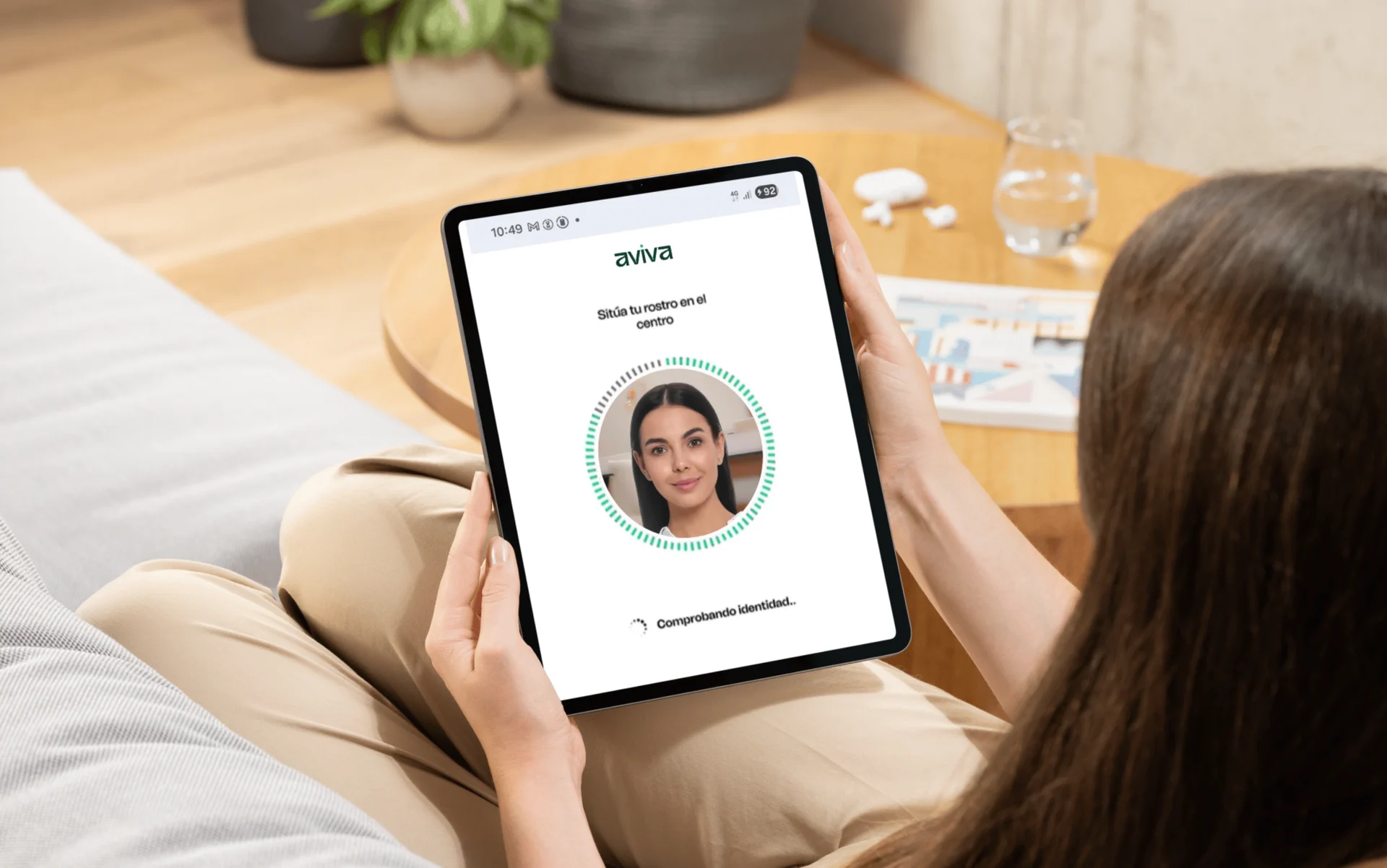
Every company needs to verify different details. A bank opening an account does not ask for the same information as an energy supplier changing the account holder on an electricity contract. That is why we start with your specific case and then select the right components.
Identity theft is the primary risk in remote onboarding. Furthermore, the onboarding process must comply with anti-money laundering (AML) and data protection (GDPR) regulations applicable to your sector. Know Your Customer (KYC) processes bring together the controls required to achieve this.
A well-designed online identity verification process protects your business without lengthening onboarding. When clients can complete the procedure from their mobile device in a single journey, drop-off rates are significantly reduced.
The components that can be combined include digital certificates, automated ID reading (OCR), facial recognition with liveness detection (Face ID), video identification (Video ID), voice biometrics, and Account Holder verification.
We work alongside you to decide which combination best matches your risk level and client profile.
Your client receives the initial notification via SMS, email, RCS, or WhatsApp, or arrives directly from your website.
They validate their mobile number or email address with an OTP code.
We scan their ID using OCR and verify their identity with Face ID.
They sign using an OTP code.
We start from a standard flow and tailor it to your process
We support any official identity document across the European Union in compliance with eIDAS, as well as from international jurisdictions. Verification is automated, with optional manual review available if contracted, such as SEPBLAC-compliant Video ID. If the process is interrupted—typically due to the user's connection—your client can restart or, where configured, resume from where they left off.
Identification solutions

Onboarding process
New client identification within remote onboarding, connected directly to your systems. Combines identification, signing, and document collection into a single journey.
When should you use this solution?
Video ID
Video identity verification for remote onboarding. Your client displays their document and identifies themselves on camera without having to travel.
When should you use this solution?
Face ID
Facial recognition and liveness detection for identity verification. It compares your client's face with the photo on their document and verifies that they are a real person.
When should you use this solution?
OCR
Automated data extraction from ID cards or residence permits using optical character recognition (OCR) to incorporate them into onboarding. Your client does not need to enter their details manually.
When should you use this solution?
Voice biometrics
Client identification by voice. We analyse the unique characteristics of their voice to verify that the person speaking is indeed who they claim to be.
When should you use this solution?
What your company receives from each onboarding process

Identification concludes when the result reaches the decision-maker: your onboarding team makes informed decisions with the verification outcome right in front of them.
At the conclusion of each onboarding process, we issue a PDF certifying the entire transaction from start to finish. We agree with you on how it is delivered to your system and stored alongside the client's file.
If onboarding concludes with a signature, the audit trails for both identification and signature can be preserved together in TES.
We host all data within the European Union and act as a data processor or sub-processor, depending on the workflow.
Retention periods for images, videos, and biometric data are governed by your contract, in accordance with the regulatory requirements of your industry.
Client identification.
Signature or acceptance.
Submitted documents.
What the PDF certifies
Identification tailored to your sector
In banking, identification forms an integral part of the AML/KYC checks applied by institutions before opening an account.
For energy suppliers, it serves to confirm the identity of anyone requesting a change of utility account holder.
In sharing economy platforms, it verifies the identity of users upon registration before they commence trading.
How requirements vary by sector
The customer journey adapts to the precise demands of each industry.
Integration with your systems

The API links identification directly with your application. Together, we define when it initiates, what data is required, and how the onboarding process proceeds thereafter.
Prior to launching in production, you can test the onboarding flow in our sandbox environment, supported by our team until it runs seamlessly with your application volume.
Identification is delivered via the web, and the entire journey reflects your brand identity. The outcome is returned directly to the system from which it was launched.
Your company website.
Your application.
The platform used by your onboarding team.
You can launch it from
Certified security in identification

Aviva is a telecommunications operator registered with the CNMC and a qualified trust service provider under the European eIDAS Regulation.
Our information security management system is certified under ISO/IEC 27001:2022 by TÜV AUSTRIA. Its scope encompasses video identification, a key element of this service.
Frequently asked questions about onboarding and identification

Tell us how you onboard your clients
Tell us which remote transaction your client is initiating and what details you need to verify before proceeding. We will advise you on the appropriate checks, how they integrate with your systems, and provide a tailored quotation.
Other Aviva services
Still not sure?
Complete your process with electronic signature, certified communications, messaging channels, and custody in TES.